A friend calls me up and is telling me about this problem they are having at work. My initial instinct would have been to to jump in and start asking questions to help and solve the problem, its what I do, I help people define the real root of the challenge and move quickly to solutions. I am highly capable at doing this… just one problem — do they actually want help?
The context for this call was a friend who actually just wanted to complain and be heard, they didn’t want solutions, or for me to ask a bunch of annoying questions to get to the root of the issue. Just because I have the capability to help them, doesn’t mean this is the context to do it.
This is the inconvenient truth that trips up a lot of teams:
AI adoption isn’t just about capabilities — it’s about context.
Real human, real messy, real un-automatable context.
It’s not enough to identify a “good use case.” You need to understand the situation — the moment, the motivation, the mindset — of the person you’re designing for (including when to introduce a solution… for my friend this was not on the call, it was when we met up for drinks later that week).
Your use case might be a customer trying to file a claim at 11 p.m. or a colleague juggling six platforms just to complete a routine task, your AI needs to speak fluently in their world, not yours. It needs to slot neatly into their actual workflow, not the idealized one you mapped out, otherwise it won’t matter to them and they will ignore it, just like my friend would have ignored any advice at that moment.
That’s why I love the framing in this piece:
“You’re not just looking for a task. You’re looking for a task that someone wants help with, and is willing to accept help on.”
Spot on. Especially the second part.
So before we celebrate another LLM integration or task automation, we need to ask:
🔍 What’s the actual workflow this plugs into?
👤 Who is the human on the other end — and what do they care about?
🧠 Is the solution enhancing trust and usability, or is it just adding noise?
Whether you’re building for end users or internal teams, it’s the same principle: Adoption is a trust exercise.
Earn it by starting with empathy, not just engineering.
We’ve been working with companies on redesigning their innovation processes. They asked for this help — but we have also been softly working with them to introduce new ways of working with AI.
Innovation is where we have permission, but the changes and the lessons here will become the foundation for a broader change with AI more generally.
Here are some lessons we hope you take into any work you do with an organization and AI.

—————————————————————
When AI Tries to Be the Expert, It Undermines the Actual One
When we don’t look at AI as a way in to augment the natural talent, ability, and workflows that people create — and instead look at it as a way to replace that knowledge, its a surefire way to lose trust.
Your colleagues and employees need to become the managers of the new AI capabilities. This new tool should be inserted into the workflow where it can do amazing amount to offer insight (“Here’s a risk you may want to check”) versus being programmed to say it knows better (“This is the best way to do something”).
AI needs to work with people to learn their expertise and elevate it, not eclipse it. When your users already have hard-earned knowledge, they don’t want a robot bossing them around, they want a smart partner who listens. Designing an AI that announces the “right answer” may be the fastest possible route to rejection.
Give them something they couldn’t easily see, calculate, synthesize or accomplish before — and let their expertise determine what to do with it.
—————————————————————
Start with the human workflow, not the AI capability.
For any AI use case the technical task is never the real use case. if you are only understanding the task, you aren’t seeiking to understand enough of the workflow nor the value that workflow creates. At a task level you can’t see if the workflow needs to be redesigned, if its delivering the value we believe it should, and ultimately if its even the right workflow to focus on to achieve the desired value.
You need to understand the context surrounding the task: what happened before it, what comes after it, who is involved, what pressures exist, what information people trust and what outcome they are really trying to achieve.
That’s where the useful AI opportunities tend to appear.
When we skip this step we risk automating the wrong problem, the wrong step, the wrong task, and even the wrong workflows.
—————————————————————
Redesign the work, not just the task.
This is the biggest opportunity. We need to redesign work around what AI makes possible.
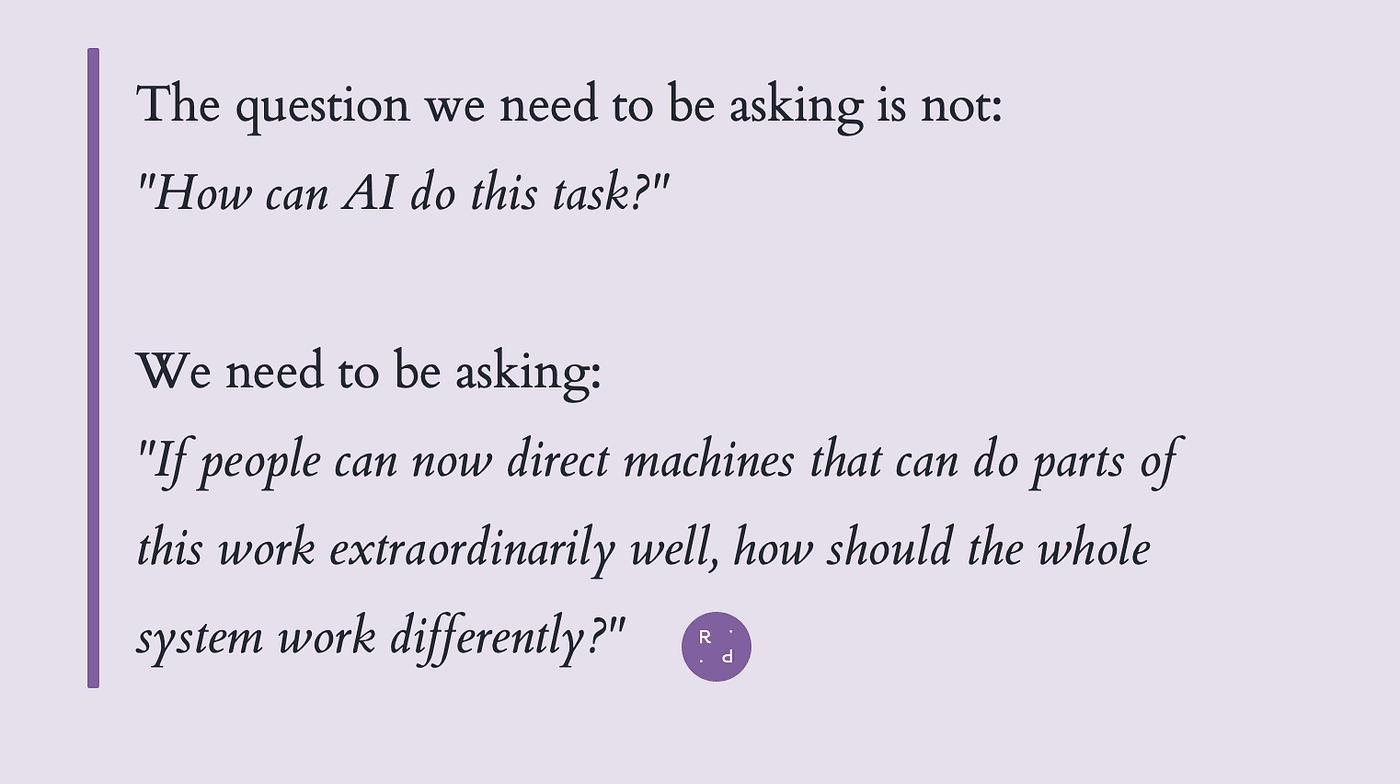
The question we need to be asking is not:
“How can AI do this task?”
We need to be asking:
“If people can now direct machines that can do parts of this work extraordinarily well, how should the whole system work differently?”
Press enter or click to view image in full size
That is partly a technology question… but it’s also a consumer question, an organizational question, a workflow question and, ultimately, a very human question.
Because adoption won’t come from proving that AI is smarter than the people doing the work.
It will come from helping those people do things they couldn’t do before.
—————————————————————
At Radical Perspective when we think about the work we do with companies across all industries to rethink how they innovate, we are not talking about task or even a single workflow. We are often using innovation and AI as a way to give the organization permission to try out these new ways of working, both as humans and as AI.
We aren’t just changing process.
We are changing how people come together to create value and how they collaborate with technology as a part of that journey.